

Enphase Energy: Microinverters, Batteries & Energy Management Explained
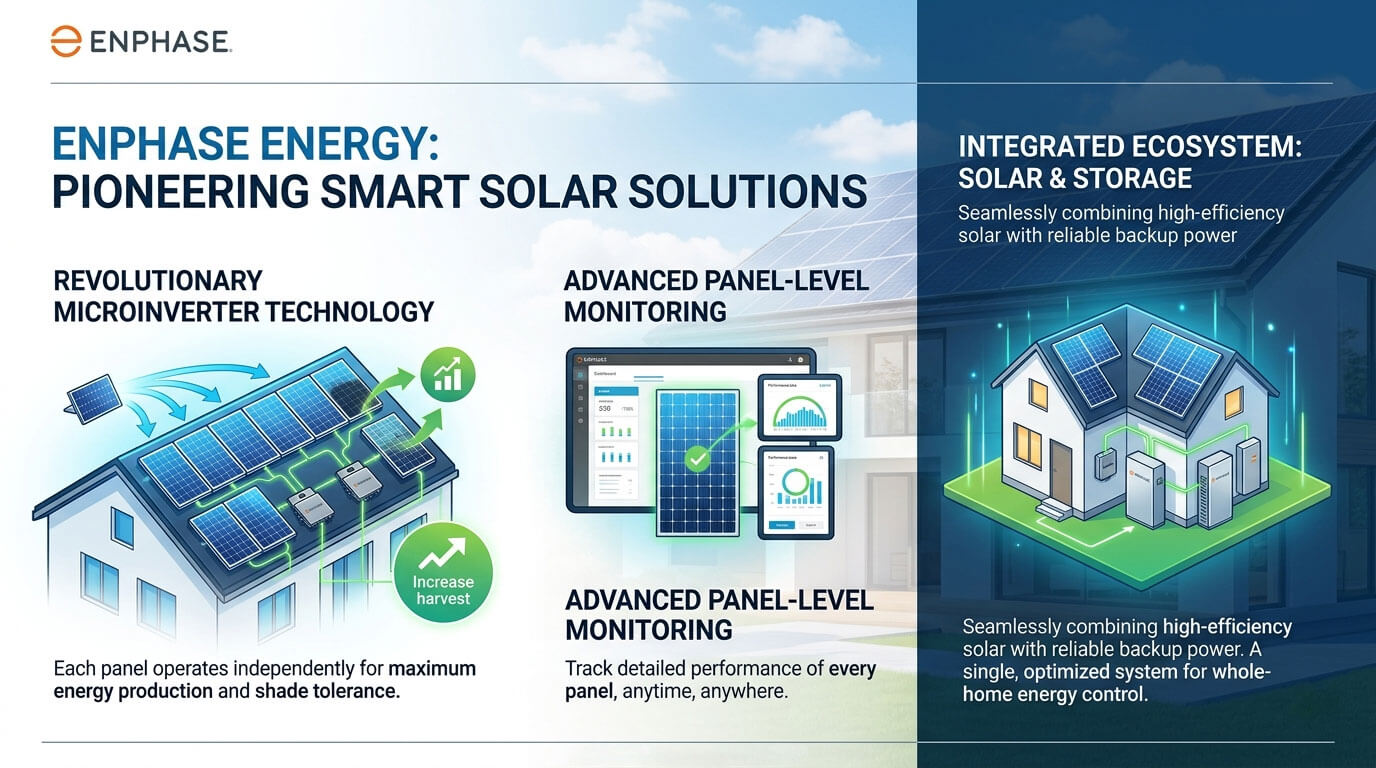
Enphase Energy is one of the most recognised names in the global solar industry, particularly in the microinverter and home energy management market. The company is best known for its Enphase IQ microinverter systems, modular battery storage solutions, and advanced solar monitoring platform.
Australian homeowners and commercial buyers often research Enphase Energy when comparing premium solar system options, especially where system reliability, panel-level optimisation, monitoring visibility, and future battery integration are priorities. Enphase products are commonly considered by buyers seeking higher-quality solar systems rather than lowest-cost installations.
Enphase equipment is generally best suited to:
- Homeowners wanting premium solar performance and monitoring
- Properties with shading or complex roof layouts
- Buyers planning future battery integration
- Customers prioritising system reliability and long-term support
- EV owners wanting integrated energy management
- Households seeking blackout backup capabilities
While Enphase systems are typically more expensive than conventional string inverter systems, they are widely regarded as one of the leading premium solar technologies available in Australia.
About Enphase Energy
Company Background
Enphase Energy is an American energy technology company founded in 2006 and headquartered in Fremont, California, USA. The business pioneered the commercialisation of solar microinverter technology and has since become one of the largest global manufacturers in the premium residential solar electronics sector.
The company initially gained attention by replacing traditional string inverter architecture with distributed microinverters installed underneath each individual solar panel. This approach fundamentally changed how residential solar systems could be designed, monitored, and managed.
Enphase now manufactures and develops:
- Solar microinverters
- Home battery storage systems
- EV charging systems
- Energy management software
- Solar monitoring platforms
- Backup energy systems
Manufacturing Locations
Enphase products are manufactured through a combination of contract manufacturing partners and global production facilities. Manufacturing has historically occurred in countries including:
- India
- Mexico
- China
- United States facilities through manufacturing partners
Manufacturing locations can vary depending on product line and market region.
Years in Operation
Enphase has operated in the solar industry for nearly two decades and is publicly traded on the NASDAQ stock exchange under the ticker ENPH.
Global Reputation
Enphase is widely considered one of the leading premium brands in the global residential solar market. The company has established strong market penetration in:
- Australia
- United States
- Europe
- New Zealand
The brand is particularly well known among solar installers for innovation in microinverter technology and advanced system monitoring.
Market Positioning
Enphase sits firmly within the premium segment of the solar market.
Compared with lower-cost inverter manufacturers, Enphase systems usually carry significantly higher upfront pricing. However, the brand positions itself around:
- Higher reliability
- Advanced monitoring
- Improved design flexibility
- Enhanced safety
- Panel-level optimisation
- Modular scalability
Enphase Product Range Overview
Enphase Microinverters
The company’s core product category is its IQ series microinverters.
Popular Australian product lines include:
- IQ7 Series
- IQ8 Series
Unlike traditional string inverters, Enphase microinverters are installed individually beneath each solar panel.
Intended Applications
Enphase microinverters are commonly used for:
- Residential rooftop solar
- Architecturally complex roofs
- Shaded roof sections
- Premium home solar systems
- Systems requiring detailed monitoring
Key Technologies
Key Enphase microinverter technologies include:
- Panel-level maximum power point tracking (MPPT)
- Module-level monitoring
- Rapid shutdown capability
- Distributed conversion architecture
- AC-coupled battery integration
Enphase Batteries
Enphase also manufactures modular home battery systems under the IQ Battery range.
These systems are designed for:
- Solar energy storage
- Backup power
- Self-consumption optimisation
- Time-of-use energy management
The modular architecture allows incremental expansion over time.
Enphase Monitoring Platform
Enphase systems integrate with the Enphase Enlighten monitoring platform, which provides:
- Panel-level production monitoring
- Consumption tracking
- Fault alerts
- Historical system analytics
- Mobile app access
The monitoring platform is often considered one of the strongest features of the Enphase ecosystem.
EV Charging
Enphase has expanded into EV charging solutions in some markets, although Australian product availability may vary over time.
Is Enphase Energy Good Quality?
Manufacturing Standards
Enphase products are generally regarded as high-quality solar electronics within the residential solar industry. The company’s products are certified to various international electrical and safety standards relevant to solar equipment.
Australian-approved products must also comply with local standards and Clean Energy Council requirements where applicable.
Reliability Reputation
Enphase has built a strong reputation for reliability compared with many lower-cost inverter brands.
One major advantage of microinverter architecture is the absence of a single central inverter failure point. In a traditional string inverter system, a single inverter failure can stop the entire solar array. With Enphase microinverters, failure of one unit typically affects only one panel.
This distributed architecture is often viewed positively by installers and homeowners focused on long-term uptime.
Installer Sentiment
Installer opinions on Enphase are generally positive within the premium solar market.
Common installer praise includes:
- Excellent monitoring capability
- Flexible system design
- Strong technical support
- Simplified fault identification
- Strong performance on complex roofs
However, installers also commonly mention:
- Higher upfront costs
- More complex installation wiring
- Longer installation times in some scenarios
Independent Certifications
Enphase products used in Australia are generally tested against relevant international and Australian standards.
However, buyers should always verify:
- Current Clean Energy Council approval status
- Product certification validity
- Installer accreditation
because approved product lists can change over time.
Build Quality
Enphase microinverters are typically regarded as robustly engineered products with high-quality electronic design and weather-resistant construction suitable for rooftop installation.
The company’s IQ series products have increasingly focused on thermal durability and environmental resistance.
Common Strengths
Commonly cited strengths include:
- Excellent monitoring
- Strong system redundancy
- High design flexibility
- Good shading performance
- Premium software ecosystem
- Strong safety profile
Common Weaknesses
Commonly cited weaknesses include:
- Premium pricing
- Higher installation complexity
- Potentially higher servicing labour costs
- Ecosystem lock-in compared with open systems
Efficiency & Performance
Microinverter Efficiency
Modern Enphase IQ microinverters generally operate with high conversion efficiencies relative to other premium inverter technologies.
Actual performance varies depending on:
- Panel pairing
- Roof orientation
- Temperature
- Shading conditions
- System design
Shading Performance
One of Enphase’s strongest performance advantages is partial shading management.
Because each panel operates independently through its own microinverter:
- Shading on one panel does not heavily reduce output across the entire system
- Different roof orientations can perform more efficiently
- Panel mismatch losses are reduced
This can be particularly beneficial for Australian homes with:
- Trees
- Multiple roof faces
- Dormers
- Complex architectural layouts
Temperature Performance
Australian rooftop conditions can become extremely hot, particularly in Queensland, Western Australia, and inland regions.
Enphase products are designed for high-temperature rooftop environments, although all electronics experience some efficiency reduction under extreme heat.
Real-world performance depends heavily on:
- Roof ventilation
- Installation quality
- Ambient climate
- Panel operating temperatures
Low-Light Performance
Panel-level optimisation can improve low-light energy harvesting compared with some conventional string inverter systems.
However, actual gains vary significantly depending on site conditions.
Battery Efficiency
Enphase IQ Batteries are AC-coupled systems. AC-coupled systems can offer installation flexibility but may experience additional conversion stages compared with some DC-coupled architectures.
Real-world battery efficiency depends on:
- Usage profile
- Charge/discharge cycling
- Backup configuration
- System sizing
Real-World Australian Performance
Enphase systems are generally well suited to Australian conditions where:
- Roof complexity exists
- High system uptime is important
- Monitoring visibility is valued
- Battery expansion is planned
However, on simple unshaded roofs, the performance gains over quality string inverter systems may be smaller relative to the additional cost.
Warranty & Support
Product Warranty
Enphase is well known for offering long product warranties on its microinverters.
For products activated after September 30, 2025, Enphase offers the following limited-warranty:
| Product | Limited Warranty Period |
| IQ9 microinverters | 25 years from the Activation Date |
| IQ8 microinverters | 25 years from the Activation Date |
| IQ7 microinverters | 10 years from the Warranty Start Date |
Warranty periods vary by model and market but are commonly longer than many standard string inverter warranties.
Buyers should verify the exact warranty applicable to their Australian product model at the time of purchase.
Battery Warranty
Enphase IQ Batteries typically include:
- Product warranty periods
- Capacity retention warranties
- Throughput conditions
Battery warranties often include performance conditions linked to total energy throughput and remaining usable capacity over time.
Visit Enphase Warranties for more information.
Australian Support Availability
Enphase maintains Australian market operations and support networks through distributors, installers, and local support infrastructure.
Support quality can vary depending on:
- Installer capability
- Distributor responsiveness
- Product generation
- Warranty claim complexity
Warranty Claim Reputation
Installer feedback regarding Enphase warranty support is generally stronger than many budget-tier solar brands.
However, warranty experiences can still vary substantially depending on:
- Installation quality
- Documentation
- Fault diagnosis
- Installer involvement
As with any solar equipment manufacturer, successful warranty outcomes often depend heavily on using experienced accredited installers.
How Long Does Enphase Equipment Last?
Microinverter Lifespan
Enphase microinverters are designed for long operational lifespans and are often marketed as having service life expectations exceeding 20 years.
Actual lifespan depends on:
- Climate exposure
- Roof heat
- Installation quality
- Electrical conditions
- Environmental stress
Battery Lifespan
Enphase battery lifespan depends primarily on:
- Charge cycle frequency
- Depth of discharge
- Operating temperatures
- Backup usage
- System configuration
Most lithium-based home batteries gradually lose storage capacity over time.
Coastal Durability
Australian coastal environments can accelerate corrosion risks for solar equipment due to salt exposure.
Proper installation practices and suitable product selection remain critical for coastal installations.
Heat Resistance
High heat is one of the largest long-term stressors on rooftop electronics in Australia.
Enphase has progressively improved thermal management across newer IQ product generations, although no rooftop electronics are completely immune to heat-related ageing.
Long-Term Reliability Expectations
Industry perception generally considers Enphase among the more reliable premium residential solar electronics brands available in Australia.
However, long-term reliability always depends on:
- Correct system design
- Professional installation
- Appropriate maintenance
- Environmental conditions
Pros and Cons
Pros
- Excellent panel-level monitoring
- Strong shading performance
- Flexible system design
- No single central inverter failure point
- Premium software ecosystem
- Strong safety architecture
- Scalable battery integration
- Suitable for complex roofs
- Strong installer familiarity in premium market
Cons
- Higher upfront system cost
- More expensive than many string inverter systems
- Additional rooftop electronics
- Potentially higher labour costs for servicing
- Some systems may be over-specified for simple roofs
- Ecosystem dependence on Enphase platform
Is Enphase Worth the Money?
Price Positioning
Enphase is generally considered one of the more expensive residential solar system architectures available in Australia.
Systems using Enphase microinverters usually cost more than comparable string inverter systems.
Value Proposition
The additional cost may be justified for buyers prioritising:
- Premium monitoring
- Roof complexity
- Future expandability
- Redundancy
- High-end system design
- Battery integration flexibility
ROI Considerations
Financial return depends heavily on:
- Electricity prices
- Feed-in tariffs
- Self-consumption rates
- Battery usage
- Installation cost
- Roof conditions
In some cases, a high-quality string inverter system may deliver similar financial returns at lower upfront cost.
However, Enphase buyers are often motivated by reliability, monitoring, and design flexibility rather than lowest-cost ROI alone.
Best Customer Fit
Enphase is often best suited to:
- Premium residential buyers
- Long-term homeowners
- Smart-home adopters
- Complex roof designs
- Future battery users
- High-monitoring visibility users
Enphase vs Competitors
Enphase vs SolarEdge
SolarEdge Technologies is one of Enphase’s primary competitors in panel-level optimisation.
Key Differences
| Feature | Enphase | SolarEdge |
| Architecture | Microinverters | String inverter + optimisers |
| Failure Point | Distributed | Central inverter remains |
| Monitoring | Panel-level | Panel-level |
| Battery Integration | Strong AC-coupled ecosystem | Strong DC-coupled options |
| Roof Flexibility | Excellent | Excellent |
| Upfront Cost | Typically higher | Often slightly lower |
Some installers prefer Enphase for redundancy, while others prefer SolarEdge for system efficiency and DC-coupled battery architectures.
Enphase vs Fronius
Fronius International is a premium string inverter manufacturer widely respected in Australia.
Key Differences
| Feature | Enphase | Fronius |
| Architecture | Microinverters | String inverter |
| Monitoring Granularity | Panel-level | System-level by default |
| Shading Management | Strong | Depends on design |
| Cost | Higher | Lower |
| Installation Simplicity | More complex | Simpler |
Fronius systems may provide better value on simple, unshaded roofs.
Enphase vs Huawei
Huawei has become increasingly popular in Australian solar and battery markets.
Huawei systems are often chosen for:
- Competitive pricing
- Battery integration
- Hybrid inverter capabilities
Enphase typically differentiates itself through:
- Premium monitoring
- Microinverter architecture
- Distributed redundancy
What Installers and Owners Say
Installer Feedback
Installer sentiment toward Enphase is generally positive within the premium residential market.
Common installer praise includes:
- Reliable monitoring platform
- Excellent fault diagnostics
- Strong system flexibility
- High customer satisfaction
- Good support ecosystem
Customer Feedback
Homeowners commonly praise:
- Visibility into panel performance
- App usability
- Reliability
- Expandability
- Backup capability options
Common Complaints
Common criticisms include:
- Higher upfront costs
- Longer payback periods
- Complexity compared with simple string systems
- App or connectivity frustrations in some cases
Industry Perception
Within the Australian solar industry, Enphase is generally regarded as:
- A premium-tier brand
- Technically advanced
- Installer-focused
- Strong in smart energy integration
Performance in Australian Conditions
High Heat Suitability
Enphase systems are commonly installed throughout hot Australian climates including Queensland and Western Australia.
Proper installation practices remain essential to minimise heat-related stress.
Hail Resistance
Microinverters themselves are mounted beneath panels, providing some physical protection from direct hail exposure.
However, overall system hail resilience depends heavily on panel selection.
Coastal Areas
Enphase systems can be suitable for coastal installations when properly specified and installed.
Corrosion-resistant mounting systems and correct installation practices remain critical.
Cyclonic Regions
Suitability for cyclonic regions depends primarily on:
- Mounting engineering
- Panel certification
- Local compliance standards
Not all solar systems are automatically suitable for high-wind cyclone-prone regions.
Australian Compliance Standards
Australian-installed Enphase products should comply with relevant standards including:
- AS/NZS electrical standards
- Grid connection requirements
- CEC-approved equipment requirements where applicable
CEC Approval
Many Enphase products have historically appeared on approved Australian Clean Energy Council equipment lists.
However, approval status can change over time and should always be verified directly before installation.
Who Should Buy Enphase?
Ideal Buyers
Enphase is typically best suited to:
Premium Homeowners
Buyers prioritising long-term reliability and advanced monitoring.
Complex Roof Homes
Homes with multiple orientations, shading, or architectural complexity.
Smart Energy Users
Households wanting:
- Battery integration
- Energy analytics
- EV charging integration
- Backup capability
Long-Term Property Owners
Owners intending to remain in the property for many years may benefit more from the premium system architecture.
Potentially Less Suitable Buyers
Enphase may be less suitable for:
- Lowest-cost solar shoppers
- Very simple unshaded roofs
- Budget-focused investment properties
- Buyers prioritising shortest payback period
Final Verdict
Enphase Energy is widely regarded as one of the leading premium residential solar technology brands available in Australia.
Its strongest advantages include:
- Excellent monitoring
- Flexible system design
- Strong shading performance
- Distributed redundancy
- Advanced smart energy ecosystem
The company’s microinverter architecture offers meaningful benefits for many homes, particularly properties with complex roof layouts or buyers prioritising long-term system visibility and scalability.
However, Enphase systems also come with significantly higher upfront costs than many traditional string inverter systems. For simple roofs with minimal shading, the financial performance difference may not always justify the additional expense.
Overall, Enphase is typically best suited to buyers prioritising premium performance, monitoring, and long-term energy management flexibility rather than lowest-cost solar installation.
Frequently Asked Questions
Is Enphase a good solar brand?
Yes. Enphase is generally considered one of the leading premium solar electronics brands globally, particularly for residential microinverter systems.
Are Enphase microinverters reliable?
Enphase microinverters are widely regarded as reliable compared with many competing inverter technologies, although no electronic product is completely failure-proof.
Is Enphase better than a string inverter?
It depends on the installation. Enphase may perform better on shaded or complex roofs, while quality string inverter systems may provide better value on simple unshaded roofs.
How long do Enphase microinverters last?
Enphase microinverters are designed for long operational life, often exceeding 20 years under suitable conditions.
Is Enphase worth the extra cost?
For some buyers, yes. The additional cost may be worthwhile for those prioritising monitoring, redundancy, flexibility, and premium system design.
Does Enphase work well in Australia?
Yes. Enphase systems are commonly installed throughout Australia and are generally well suited to Australian residential conditions.
Can Enphase systems work during a blackout?
Some Enphase battery and backup configurations can provide backup power functionality, depending on system design and installed components.
Does Enphase make batteries?
Yes. Enphase manufactures the IQ Battery range for residential energy storage applications.
Is Enphase suitable for shaded roofs?
Yes. One of Enphase’s main strengths is panel-level optimisation, which can improve performance on partially shaded roofs.
Is Enphase better than SolarEdge?
Both are premium technologies with different architectures. Enphase uses microinverters, while SolarEdge uses power optimisers with a central inverter.
Does Enphase have Australian support?
Enphase operates within the Australian market through distributors, installers, and support networks.
Are Enphase systems expensive?
Compared with many conventional string inverter systems, Enphase systems are generally considered premium-priced.